Dryp Yoga: What It Is and Complete 2026 Guide
Dryp Yoga is a heated yoga studio brand offering multiple class formats, including yoga sculpt and hot flow, in a premium studio environment designed to make heated yoga accessible and effective for a wide range of practitioners. If you’ve seen the name and wondered what makes it different from every other hot yoga studio on the block, this guide gives you the honest, practical answer before you ever walk through the door.
The National Center for Complementary and Integrative Health reports that yoga practice among American adults has grown consistently over the past decade, with millions citing stress relief, flexibility improvement, and general fitness as their primary motivations. Heated yoga formats like those offered at Dryp-style studios add physiological complexity to these benefits, and understanding that complexity helps you prepare properly and choose the right class for your body.
You’ll find everything here: what the studio concept represents, how each class format works, what the research says about heated yoga’s real benefits, who should approach with caution, and how to build a practice that actually fits your life and body.
What Is Dryp Yoga and How Does It Work?
Dryp Yoga is a boutique heated yoga studio concept offering class formats that combine traditional yoga postures, functional fitness movements, and strength-based exercises in a climate-controlled heated room.
The name “Dryp” signals the studio’s identity: heat, sweat, and effort, delivered in a premium environment that positions itself as a step above generic gym yoga or conventional Bikram-only studios. The class experience is designed to be modern, music-driven, and accessible to practitioners across a range of fitness levels, from complete beginners to athletes looking for active recovery.
What sets boutique heated yoga studios like Dryp apart from large-format hot yoga chains is the format diversity. Rather than a single fixed sequence repeated every session, Dryp-style studios typically offer multiple class types across different intensities, durations, and physical demands. The result is a studio where a beginner can find an appropriate entry point and an experienced practitioner can find a challenge without either being stuck in the wrong room.
The heated room environment, typically maintained between 85 and 98°F depending on the class format, produces the physiological effects common to all heated yoga: faster muscle warming, enhanced connective tissue pliability, elevated cardiovascular demand, and post-class nervous system recovery that many practitioners describe as deeper and more sustained than room-temperature yoga produces.
Quick Summary: Dryp Yoga at a Glance
- Studio type: Boutique heated yoga, multiple format options
- Room temperature: Approximately 85 to 98°F depending on class
- Class formats: Sculpt, Flow, Hot, Restorative, and variations
- Who it suits: Beginners through experienced practitioners
- Community feel: Smaller class sizes, music-driven, modern aesthetic
Dryp Yoga vs Hot Yoga: What’s the Difference?
Dryp Yoga differs from conventional hot yoga primarily in format diversity and studio positioning, offering multiple class styles in a heated environment rather than a single fixed sequence.
Conventional hot yoga, particularly the Bikram or 26&2 format, uses one fixed sequence of 26 postures and 2 breathing exercises, repeated identically in every class at 105°F with 40% humidity. The structure is predictable and the progress trackable over time. It suits practitioners who want the same framework every session.
Dryp-style studios offer a different value proposition. The heated room is the shared element, but the physical practice inside varies by class type, teacher, and day. A hot sculpt class at Dryp looks nothing like a hot flow class, which looks nothing like a heated Yin session. This variety retains practitioners who find a single fixed sequence tedious and appeals to those coming from a fitness background who want more than posture-only yoga.
| Feature | Dryp Yoga Style | Bikram / 26&2 |
|---|---|---|
| Sequence | Varies by class type | Fixed 26 postures, every class |
| Room temperature | 85 to 98°F | 105°F exactly |
| Humidity | Variable, typically lower | 40% consistently |
| Formats offered | Multiple (Sculpt, Flow, Yin, etc.) | One format only |
| Equipment used | Sometimes includes weights | No equipment |
| Best for | Variety seekers, fitness enthusiasts | Structure seekers, measurable progress |
The lower temperature of Dryp-style studios compared to Bikram also affects who can access the practice comfortably. Many people who find the 105°F Bikram environment overwhelming report that the 85 to 95°F range of a Dryp-style class feels genuinely manageable.
Dryp Yoga Class Formats: Sculpt, Flow, and More
Dryp Yoga typically offers three to five class formats that vary in physical intensity, movement style, and equipment use, allowing practitioners to choose based on their fitness level, goals, and recovery needs on any given day.
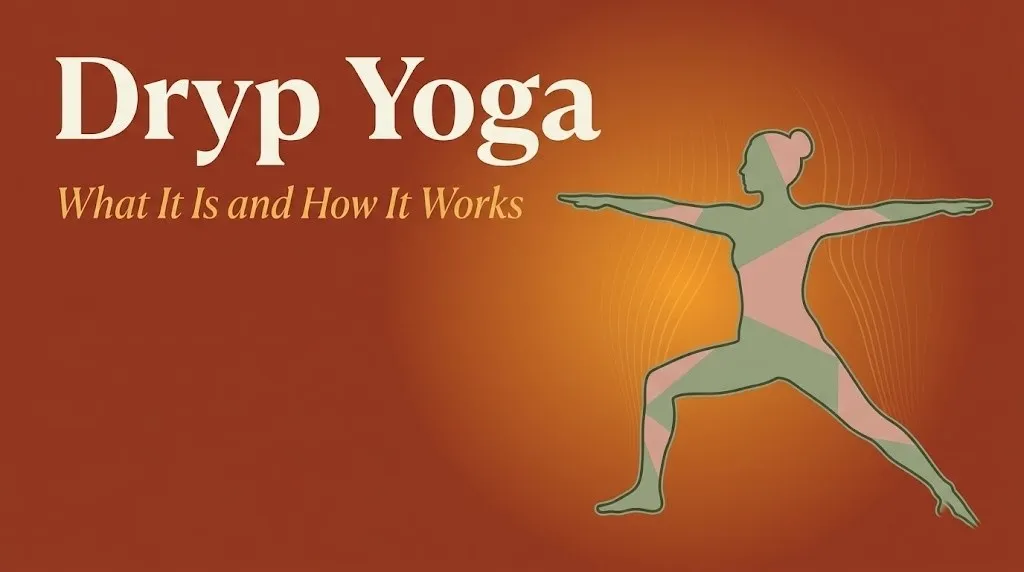
The core formats you’ll find at most Dryp-style studios include:
- Hot Flow / Hot Vinyasa: A breath-linked flowing sequence practiced in a heated room between 90 and 98°F. Movements are connected to breath. No external equipment. Suitable for students with some prior yoga experience, though beginner flow options are commonly offered.
- Yoga Sculpt: A hybrid format combining yoga postures with strength training exercises using light dumbbells (typically 1 to 5 lb) and sometimes resistance bands. The room is heated, often slightly lower than a pure hot flow class. This format builds lean muscle while maintaining the flexibility and breath-awareness benefits of yoga.
- Hot Hatha: A slower, alignment-focused heated class where poses are held longer than in Vinyasa. Better suited to beginners and those prioritizing technique over pace.
- Heated Yin or Restorative: Practiced at lower temperatures, typically 85 to 88°F, with long passive holds of 3 to 5 minutes per pose. The goal is connective tissue release and nervous system recovery.
According to the International Journal of Yoga, yoga practiced twice weekly over 8 weeks produced measurable improvements in flexibility, balance, and self-reported well-being in adults across a range of ages and fitness backgrounds. The format you choose determines which of these outcomes you prioritize in each session.
Key Takeaway: Dryp Yoga’s format diversity is its defining feature. Choosing the right class type from the start, not just the nearest available time slot, determines whether your first experience matches your body’s current capacity.
What Is Yoga Sculpt and How Does It Differ from Hot Yoga?
Yoga sculpt is a hybrid fitness format that combines yoga postures with strength training exercises using light hand weights and bodyweight resistance, practiced in a heated room to amplify cardiovascular demand and muscle warmth.
The distinction from pure hot yoga is fundamental. Traditional hot yoga formats, whether Bikram, hot Vinyasa, or hot Hatha, use only the body’s own weight as resistance. Yoga sculpt introduces external load through light dumbbells, resistance bands, or bodyweight exercise sequences like squats, lunges, and push-up variations inserted between yoga postures.
This combination produces a different physiological outcome than yoga alone. Strength-based movements in a heated room elevate heart rate higher than most yoga-only classes, increase the demand on the quadriceps, glutes, and upper body, and build lean muscle tissue in addition to the flexibility and balance benefits that yoga postures provide.
The American College of Sports Medicine classifies yoga sculpt as moderate to vigorous intensity physical activity depending on the load used and the pace maintained, placing it within the evidence base for cardiovascular health improvement and body composition change.
To practice a basic sculpt-style Utkatasana (Chair Pose) variation with weights:
- Stand in Tadasana (Mountain Pose) with feet hip-width apart and a light dumbbell in each hand.
- Bend the knees to lower the hips as if sitting into a chair, thighs approaching parallel to the floor.
- Keep the knees tracking directly over the second toe.
- Curl the dumbbells upward in a bicep curl while holding the Chair Pose position.
- Hold for 5 breath cycles, then slowly straighten the legs on an exhale.
Modification note: Anyone with knee osteoarthritis should reduce the depth of the squat to a pain-free range. Hold the chair position without weights until knee strength and confidence are established.
Dryp Yoga Benefits Backed by Research
Dryp-style heated yoga produces measurable physical and psychological benefits through two overlapping mechanisms: the well-documented effects of yoga practice itself and the additional physiological effects of exercising in a warm environment.
The National Center for Complementary and Integrative Health reviewed multiple clinical trials on yoga and found consistent evidence for reduced chronic lower back pain, improved sleep quality, decreased anxiety symptoms, and better functional balance across adult age groups. These benefits apply to any yoga format practiced consistently, heated or not.
Heat adds its own documented layer. Research published in the Journal of Alternative and Complementary Medicine found that Bikram yoga practiced over 12 weeks produced small but measurable improvements in grip strength, shoulder flexibility, and deadlift strength in sedentary adults, with no adverse cardiovascular events in healthy participants.
Key benefits with research support:
- Improved flexibility: Connective tissue becomes more pliable at elevated temperatures, producing faster flexibility gains than room-temperature yoga for equivalent session frequency
- Cardiovascular conditioning: Heart rate elevation in warm environments adds aerobic demand to yoga movement, improving cardiovascular endurance over 8 to 12 weeks
- Reduced cortisol: Multiple reviewed studies document post-session cortisol reduction following yoga practice
- Lean muscle development: Yoga sculpt formats specifically add hypertrophic stimulus through external resistance
- Improved balance: Particularly documented in adults over 50 in multiple yoga-specific trials
Heated Yoga for Flexibility and Joint Health
Heated yoga is particularly effective for flexibility because elevated room temperature reduces the mechanical stiffness of connective tissue, making it more responsive to sustained stretching than it would be at room temperature.
Think of fascia and tendons at room temperature like cold butter: resistant, slow to yield, requiring significant force to change shape. Warmed tissue behaves more like room-temperature butter: pliable, responsive, requiring far less force to lengthen. The heated studio does in minutes what would take 20 minutes of active warm-up in a cool space.
Joint health in a heated yoga context is more nuanced. Warmth reduces the viscosity of synovial fluid, the joint lubricant, which improves mobility and reduces the friction sensation common in early-morning joints. For people managing mild osteoarthritis in the hips or thoracic spine, this effect can make movement feel noticeably more comfortable during a warm session.
The caution for hypermobile practitioners deserves emphasis. Anyone with ligamentous laxity or diagnosed hypermobility should avoid using the heat as permission to push past their natural range. Stability and muscle engagement matter more in a heated room than depth of stretch, because the reduced muscular resistance that heat produces can lead hypermobile bodies beyond safe joint limits before pain signals appear.
To practice Anjaneyasana (Low Lunge) for hip flexor length in a heated room:
- Kneel on the mat with both knees down.
- Step the right foot forward until the right knee is directly above the right ankle.
- Lower the left knee to the mat. Place a folded blanket beneath it for comfort if needed.
- On an inhale, lengthen the spine upward. On an exhale, gently shift the hips forward.
- Hold for 5 to 8 breath cycles. Switch sides.
Modification note: For knee pain in the back leg, double-fold a yoga blanket under the back knee. For hip flexor tightness so severe that the hips cannot square forward, keep hands on the front thigh rather than reaching the arms overhead.
Heated Yoga for Stress and Mental Health
Heated yoga reduces stress through two overlapping physiological mechanisms: the mindfulness required by breath-linked movement in a warm room, and the parasympathetic nervous system activation that follows sustained heat exposure and cool-down.
Ujjayi pranayama (victorious breath), the slow audible nasal breathing used throughout most hot yoga class formats, directly activates the vagus nerve. Vagal activation slows heart rate, lowers blood pressure modestly, and shifts the nervous system away from the stress-response state. The heat in the room intensifies the body’s physiological engagement, which makes the focus demanded by the class harder to fake and more genuinely effective as a mental reset.
Research published in Complementary Therapies in Medicine found that participants practicing hot yoga twice weekly over 8 weeks showed measurable reductions in perceived stress scores and improvements in heart rate variability, a marker of autonomic nervous system health and stress resilience. These outcomes were present in both beginners and experienced practitioners.
The post-class experience at a Dryp-style studio often includes an extended Savasana (Corpse Pose) period where the room cools slightly and the nervous system integrates the regulatory effects of the preceding session. This final rest is physiologically active, not passive waiting. Skipping it is the most consequential error most beginners make in any heated yoga format.
Pose Tip: Stress-Relief Priority Practices
- Savasana (Corpse Pose): Minimum 5 minutes. The post-heat parasympathetic response peaks during this window.
- Balasana (Child’s Pose): Take it freely during class whenever overwhelmed. It’s a regulatory tool, not a retreat.
- Ujjayi pranayama throughout class: If you lose the breath, you lose the primary stress-reduction mechanism.
Key Takeaway: The stress relief from heated yoga comes primarily from the vagus nerve activation driven by ujjayi breathing, not from sweating. The breath is the mechanism. The heat amplifies the demand for it.
Heated Yoga and Weight Management: Realistic Expectations
Heated yoga supports weight management, but the calorie-burn figures in studio marketing consistently overstate what peer-reviewed research actually measures.
A 90-minute Bikram yoga session burns an average of 330 to 460 calories according to research conducted at Colorado State University, comparable to a moderate 90-minute walk. Yoga sculpt classes produce somewhat higher calorie expenditure due to the added resistance training component, but the “1,000 calorie per class” figures that circulate in activewear marketing are not supported by any published study.
The weight loss observed on a scale immediately post-class is water weight from sweat, not fat. An average heated yoga class produces 500 milliliters to 1.5 liters of sweat loss, which reverses completely with rehydration. Treating this as meaningful fat loss is a widespread misunderstanding that leads to poor hydration behavior.
The genuine body composition benefit of regular heated yoga comes from a more sustainable mechanism. Consistent practice builds lean muscle tissue, particularly in yoga sculpt formats, improves insulin sensitivity through regular moderate-intensity cardiovascular work, and reduces cortisol, which promotes abdominal fat storage when chronically elevated. A study published in the Journal of Strength and Conditioning Research found that 8 weeks of Bikram yoga produced small but measurable body composition improvements in sedentary adults independent of dietary changes.
- Realistic calorie burn: 330 to 460 calories per 90-minute hot yoga session
- Yoga sculpt calorie burn: Somewhat higher due to resistance component
- Water weight loss per session: 500ml to 1.5 liters (must be replaced, not celebrated)
- Body composition timeline: 8 to 12 weeks of consistent twice-weekly practice
Is Dryp Yoga Safe for Beginners?
Dryp Yoga is safe for most healthy beginners when they start with a beginner-designated class, arrive well-hydrated, and communicate with the teacher about their experience level before class begins.
The heated environment adds physiological demand that room-temperature yoga does not, primarily through cardiovascular elevation and increased sweat rate. Neither of these is dangerous for healthy adults, but both require preparation that beginners often underestimate. The most common beginner challenges are dizziness, light-headedness, and nausea, all caused by dehydration or standing up too quickly from a floor pose.
Beginner safety guidelines for any Dryp Yoga session:
- Arrive 10 to 15 minutes early to acclimate to the room before class begins
- Hydrate the day before, not just the morning of your first class
- Tell the teacher you are new to heated yoga before class starts
- Take Balasana (Child’s Pose) freely and without hesitation whenever the room or effort level feels too much
- Rise slowly from any floor pose to standing; allow blood pressure to equalize before moving
- Do not lock your knees in any standing pose; this restricts venous return and raises fainting risk
The NCCIH notes that yoga is well-tolerated across a wide range of fitness levels and health backgrounds. The heated component adds demand, but for healthy adults arriving prepared, it is manageable and beneficial.
Modification note: Anyone with a history of heat exhaustion, heat syncope, or heat intolerance should begin with a non-heated class and introduce the warm environment gradually over several weeks.
Dryp Yoga and Heart Health: Who Needs to Be Careful
Heated yoga places additional demand on the cardiovascular system, and certain individuals should get medical clearance before starting a heated practice at Dryp Yoga or any similar studio.
The American Heart Association notes that exercise in warm environments increases heart rate above what the same physical effort produces in cooler conditions, as the body redirects blood flow toward the skin for cooling. This is a normal and manageable physiological response in healthy adults. For people with specific conditions, it requires evaluation before beginning.
People who should discuss heated yoga with their cardiologist or managing physician before starting include:
- Those with diagnosed heart disease or a history of cardiac events
- People with uncontrolled hypertension not well-managed by current medication
- Those with cardiac arrhythmias of any type
- People with autonomic nervous system disorders including POTS
- Anyone with orthostatic hypotension (blood pressure drops when standing)
- Individuals who have recently completed cardiac surgery or rehabilitation
People with mild, well-controlled hypertension may be able to begin with lower-temperature heated formats, such as a heated Hatha or Yin class at 85 to 88°F, with their physician’s awareness. A conversation with the prescribing physician before starting is appropriate, not because heated yoga is categorically dangerous for managed hypertension, but because the interaction between exercise, heat, and blood pressure medication is a relevant clinical variable for that physician to know about.
Dryp Yoga for Seniors and People with Joint Concerns
Dryp Yoga is accessible for older adults and people managing joint concerns when the appropriate class format is selected and modifications are used consistently throughout practice.
Research published in the International Journal of Yoga found that adults over 60 who practiced yoga consistently showed measurable improvements in balance scores, functional mobility, and self-reported quality of life over 12 weeks. These outcomes are particularly relevant for seniors because balance improvement directly reduces fall risk, which the Centers for Disease Control and Prevention identifies as the leading cause of injury-related death in adults over 65.
Practical recommendations for seniors at a Dryp-style studio:
- Begin with Heated Hatha or Heated Yin rather than yoga sculpt or hot flow: slower pace, longer holds, lower cardiovascular demand
- Sit near the door for easier access to cooler air and a clear exit route if needed
- Hydrate more deliberately than younger classmates: aging reduces thirst sensitivity, meaning seniors are often underhydrated before they feel thirsty
- Use props throughout every class: blocks under the hands, blankets under the knees, straps for forward folds
- Inform the teacher of joint replacements, recent procedures, or balance concerns before every class, not just the first
Seniors taking diuretics or blood pressure medications should be aware that these drugs affect heat response. Diuretics increase dehydration risk. Beta-blockers blunt the heart rate response to heat, which can mask early warning signs of heat stress. A brief conversation with the prescribing physician about exercising in a heated room is appropriate before starting.
Key Takeaway: Seniors and people with joint concerns can practice Dryp Yoga safely by starting with lower-intensity, lower-temperature formats, using props freely, hydrating aggressively, and telling the teacher about relevant health history before every class.
Dryp Yoga During Pregnancy
The American College of Obstetricians and Gynecologists (ACOG) advises pregnant women to avoid exercise in rooms heated above 102.2°F, because elevated core body temperature during the first trimester carries risk to fetal neural tube development.
Dryp Yoga rooms are typically maintained below this threshold, at 85 to 98°F, but the body’s internal temperature still rises during physical exertion in a warm environment. The ACOG guideline applies to core temperature outcome regardless of the ambient room temperature that produced it. A physically active pregnant person in an 88°F room who is working at moderate intensity can still elevate core temperature meaningfully above the guideline limit.
The practical guidance for pregnant practitioners is clear: transition to a non-heated prenatal yoga class for the duration of the pregnancy. Prenatal yoga is specifically designed for the anatomical and hormonal changes of pregnancy and includes modifications that protect the abdomen, pelvic floor, and joints in their pregnancy-adapted state.
After delivery and with physician clearance, typically at 6 to 8 weeks postpartum, returning to Dryp Yoga is appropriate. The reintroduction should be gradual: a heated Hatha or Yin class at the studio’s lowest temperature setting before returning to sculpt or vigorous flow formats.
Safety note: If a pregnant person attends a Dryp class before reading this guidance and experiences dizziness, overheating, or any decrease in fetal movement, they should exit the heated room immediately and contact their OB or midwife to discuss the situation before continuing any heated practice.
What to Wear and Bring to Your First Dryp Yoga Class
Arriving at Dryp Yoga with the right clothing and supplies removes the logistical friction that prevents many first-timers from returning after a single uncomfortable experience.
Fabric choice is the most commonly underestimated preparation decision. Cotton absorbs sweat and becomes heavy, cold, and slippery within the first 20 minutes of a heated class. Moisture-wicking synthetic fabrics made from polyester, nylon, or spandex blends move sweat away from the skin, dry faster, and maintain grip through movement. Fitted, not loose, is the practical standard. Loose fabric falls into your face in forward folds and twists.
Essential items to bring:
- Water bottle: At minimum 24 oz, 32 oz preferred. Pre-hydrating begins hours before class, not in the parking lot.
- Yoga mat: Most Dryp studios rent mats. If you own one, bring it.
- Grip mat towel: Placed over the mat. Sweat on a standard mat creates a dangerous slip surface within minutes of a hot class.
- Hand towel: Secondary towel for wiping hands and face during class.
- Change of clothes: You will be completely soaked. This is not optional planning.
- Light dumbbells (1 to 3 lb) for sculpt classes: Studios typically provide these, but confirm before your first session.
| Item | Recommended | Avoid |
|---|---|---|
| Top | Fitted moisture-wicking tank | Loose cotton T-shirt |
| Bottoms | Fitted shorts or capris, synthetic blend | Baggy cotton shorts |
| Mat | Personal mat with grip towel over it | Studio mat without towel |
| Footwear | Bare feet on mat | Socks unless grip-specific |
| Accessories | Minimal, no metal jewelry | Metal pieces that heat against skin |
What to Eat and Drink Before Dryp Yoga
Pre-class food and fluid timing for Dryp Yoga matters more than it does for most exercise formats, because digestion competes directly with thermoregulation and physical effort in a warm room.
The practical guideline from sports dietitians and experienced yoga teachers: eat a light meal 2 to 3 hours before class, or a small easily digestible snack 30 to 45 minutes prior. Starting a heated yoga class on a completely empty stomach increases dizziness and energy crash risk, particularly in sculpt formats with significant strength demands. Starting on a full stomach, especially after protein-heavy or high-fat meals, increases nausea risk substantially in a warm environment.
Foods that work before class:
- 2 to 3 hours before: Oatmeal with fruit, a small smoothie with protein and banana, brown rice with vegetables, whole grain toast with nut butter
- 30 to 45 minutes before: Half a banana, a small yogurt, a handful of almonds, a few crackers with nut butter
The American College of Sports Medicine recommends consuming 16 to 20 ounces of fluid at least 2 hours before exercise in warm environments. For sculpt classes that combine yoga movement with resistance training, the energy and fluid demands are higher than for a pure yoga flow class. Starting hydrated is a non-negotiable, not a suggestion.
Post-class electrolyte replacement is as important as the class itself. Sweat depletes sodium, potassium, and magnesium. Plain water rehydrates volume but does not replace mineral losses. Coconut water, a sodium-containing sports drink, or a balanced meal with natural electrolyte content within 90 minutes of class restores balance faster and prevents the next-morning fatigue most beginners blame on the workout itself.
How Often Should You Practice Dryp Yoga?
Most yoga teachers and sports medicine practitioners recommend starting with two Dryp Yoga sessions per week and building frequency gradually based on how well the body recovers between sessions.
Recovery in a heated yoga format is consistently underestimated by beginners. A 60-minute hot sculpt class depletes fluids, electrolytes, and glycogen stores while also applying muscular fatigue from the resistance component. Without adequate rest between sessions, cumulative fatigue develops within one to two weeks, and what feels like enthusiasm can become a barrier to consistency.
A practical frequency progression:
- Weeks 1 to 2: Two sessions per week, non-consecutive days. Focus on learning the formats and understanding how your body responds to the heat.
- Weeks 3 to 6: Two to three sessions per week, based on energy, sleep quality, and recovery.
- Week 7 onward: Three to four sessions per week for practitioners whose recovery consistently supports it.
Signs you are ready to increase frequency:
- Muscle soreness resolves within 48 hours between sessions
- Energy after class feels restorative, not depleted
- Performance in poses is stable or improving week over week
Signs to reduce frequency and rest more:
- Persistent soreness that doesn’t improve between classes
- Dizziness during class that wasn’t present in earlier sessions
- Disrupted sleep following evening classes
- Declining performance in poses you held comfortably the week before
Also worth noting: mixing Dryp Yoga with other demanding exercise, such as distance running or heavy strength training, requires treating heated yoga’s cardiovascular and thermal demand as part of the overall weekly training load.
Frequently Asked Questions About Dryp Yoga
What is Dryp Yoga and is it the same as Bikram?
Dryp Yoga is a boutique heated yoga studio concept offering multiple class formats in a warm room, while Bikram yoga is a specific fixed sequence of 26 postures practiced at exactly 105°F with 40% humidity.
Dryp-style studios typically run at lower temperatures, around 85 to 98°F, and offer diverse formats including flow, sculpt, and restorative classes rather than a single repeating sequence.
The two share the heated room element but differ substantially in structure, temperature, humidity, and class variety.
What classes does Dryp Yoga offer?
Dryp Yoga typically offers Hot Flow, Yoga Sculpt, Heated Hatha, and Heated Yin or Restorative formats across different time slots and intensity levels.
Yoga Sculpt combines yoga postures with light resistance training using dumbbells, making it a hybrid fitness and yoga format.
Checking the specific studio’s current schedule and reading each class description before booking helps match the format to your current fitness level and goals.
Is Dryp Yoga good for complete beginners?
Dryp Yoga is appropriate for complete beginners when they start with a beginner-designated or slower-paced Heated Hatha class rather than jumping into sculpt or vigorous flow.
Arriving 10 to 15 minutes early, telling the teacher it’s your first heated class, and using every modification offered dramatically improves the first experience.
Balasana (Child’s Pose) is always available during class and should be used freely any time the heat or effort feels too intense.
What should I bring to my first Dryp Yoga class?
Bring a water bottle of at least 24 ounces, a yoga mat or plan to rent one, a grip mat towel, and a change of clothes.
Hydrating with 16 to 20 ounces of water starting at least 2 hours before class is more important than any piece of equipment you bring into the room.
For sculpt classes, studios typically provide light dumbbells, but confirm this with the studio before your first session.
How often should I go to Dryp Yoga to see results?
Two to three sessions per week produces measurable flexibility, stress relief, and body composition improvements in most practitioners within four to six weeks.
Starting with two non-consecutive sessions per week allows the body to adapt to the heat and the physical demands before increasing frequency.
Consistency over weeks and months matters more than any single session’s intensity, and adequate recovery between classes protects both results and long-term motivation.
Show Up Prepared. That’s the Whole Secret.
The single most useful thing you can do with this guide is simple: drink 20 ounces of water right now and start thinking about your pre-class hydration window. Book a beginner-friendly class, arrive 15 minutes early, introduce yourself to the teacher, and accept every prop and modification offered.
Try a Heated Hatha or introductory Flow class for your first two sessions before exploring Sculpt. Let your body learn the heated environment before adding the resistance component.
The practice compounds. Every session prepares your body for the next. Start this week.