12 Basic Yoga Poses for Beginners: Expert Guide 2026
The 12 basic yoga poses for beginners form the physical foundation of nearly every yoga style practiced worldwide, and learning them correctly in the first few weeks sets the quality of your entire practice for years to come. This guide gives you the poses, the step-by-step alignment, the science behind why they work, and the cultural context of the practice you are stepping into.
Yoga’s benefits are well documented. According to the National Center for Complementary and Integrative Health (NCCIH), yoga practice is associated with improvements in chronic low back pain, anxiety, depression, and blood pressure regulation across multiple controlled study populations. These effects are accessible to absolute beginners within the first 8 weeks of twice-weekly practice.
This guide covers all 12 foundational poses with numbered alignment instructions, Sanskrit names, muscle engagement, and modifications. It also answers the questions that every beginner deserves honest answers to: what yoga means, where it came from, whether it is a religion, and how to build a sustainable home practice from scratch.
12 Basic Yoga Poses for Beginners: The Complete Guide
The 12 basic yoga poses for beginners are foundational postures selected because they develop the body awareness, muscle activation patterns, and flexibility that all more complex yoga poses build upon.
These 12 poses appear consistently across Hatha yoga, beginner Vinyasa classes, and most introductory programs globally because they address the physical patterns most adults most urgently need: spinal mobility, hip flexibility, shoulder opening, core stability, and balance. They are not a random selection. They are a deliberate curriculum.
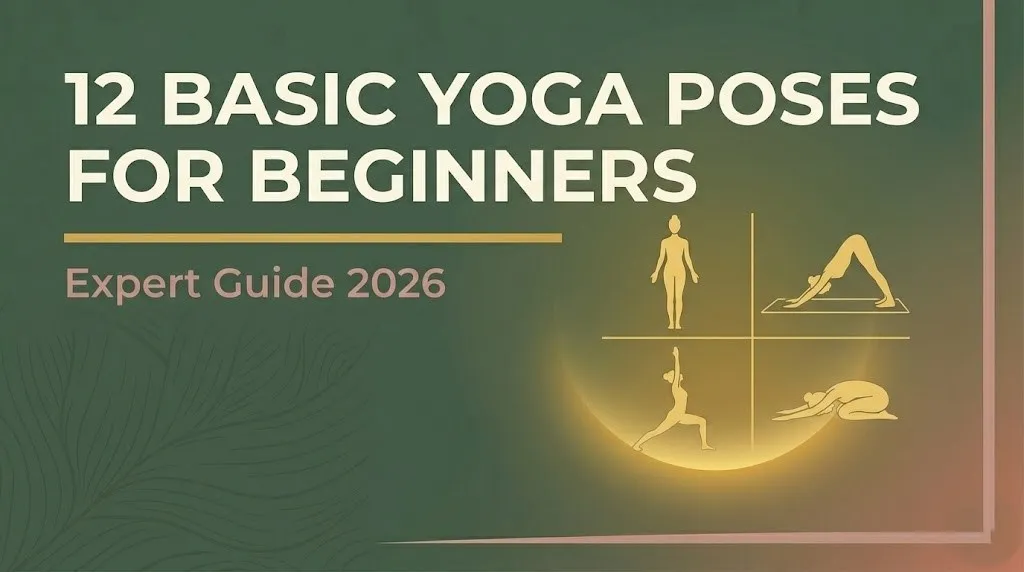
The 12 poses covered in detail in this guide are:
- Tadasana (Mountain Pose)
- Adho Mukha Svanasana (Downward-Facing Dog)
- Balasana (Child’s Pose)
- Virabhadrasana I (Warrior I Pose)
- Virabhadrasana II (Warrior II Pose)
- Trikonasana (Triangle Pose)
- Utkatasana (Chair Pose)
- Bhujangasana (Cobra Pose)
- Setu Bandha Sarvangasana (Bridge Pose)
- Vrksasana (Tree Pose)
- Marjaryasana-Bitilasana (Cat-Cow Pose)
- Savasana (Corpse Pose)
Each pose builds a specific physical quality. Each can be modified for any body. None require prior flexibility or athletic experience to begin.
Introduction of Yoga: What It Is and Why It Works
Yoga is an ancient system of physical, mental, and philosophical practices originating in the Indian subcontinent, with the physical posture practice most widely known in the West referred to as asana (the Sanskrit word for “seat” or “posture”).
The word yoga itself comes from the Sanskrit root “yuj,” meaning to yoke, join, or unite. In classical yoga philosophy, this referred to the union of individual consciousness with universal consciousness. In contemporary practice, most Western practitioners engage primarily with yoga’s physical and breath components, which are two of the traditional eight limbs of yoga described in the Yoga Sutras of Patanjali, a classical text compiled around 400 CE.
Why does yoga work as a physical practice? It works because it combines muscular strengthening, flexibility training, balance development, and breath-focused attention in a single practice format. No other common exercise modality addresses all four simultaneously. This integration is what makes even a beginner yoga session produce noticeable physical and psychological effects within the first few weeks.
According to the International Journal of Yoga, practitioners who attend yoga sessions at least twice weekly for 8 weeks show measurable improvements in flexibility, balance, and self-reported quality of life compared to non-practicing controls. Eight weeks. Twice per week. That is a realistic beginner timeline for real, documented results.
Key distinctions between yoga and other exercise forms:
- Yoga combines strength, flexibility, balance, and breath: Most exercise modalities address one or two of these. Yoga addresses all four simultaneously.
- Yoga includes a mental attention component: Directing awareness inward during practice is not a vague addition. It is associated with the stress-reduction outcomes that research documents.
- Yoga is scalable to any body: Every pose in this guide has a modification. No prior fitness is required.
What Language Is Yoga and What Does the Word Mean
Yoga is a Sanskrit word, and Sanskrit is the classical language of ancient India in which the original yoga texts were written over thousands of years.
Sanskrit is one of the oldest documented languages in the world, part of the Indo-European language family, and the liturgical language of Hinduism, Buddhism, and Jainism. It is not a spoken vernacular language in modern India. It is a classical and scholarly language, similar in its contemporary status to Latin in Western academia.
The word “yoga” derives from the Sanskrit verbal root yuj, which means to join, unite, or yoke. The same Proto-Indo-European root produces related words in English including “yoke” (as in the yoke placed on oxen) and in Latin, “jungere” (to join), from which we get words like “junction” and “conjugate.” The linguistic connection between yoga and these familiar English words is genuine and illuminating.
Pose names in yoga are Sanskrit because yoga developed within Sanskrit-speaking philosophical and scholarly traditions. When a teacher says Adho Mukha Svanasana, they are using the original Sanskrit name that has accompanied this pose through thousands of years of transmission. The English translation, Downward-Facing Dog, is a convenience. The Sanskrit name is the original.
Common Sanskrit yoga terms beginners encounter:
- Asana: Posture or pose
- Pranayama: Breath control (prana = life force; ayama = extension)
- Namaste: A respectful greeting meaning “I bow to you”
- Vinyasa: A breath-synchronized movement system
- Drishti: Focused gaze point during practice
- Savasana: Corpse pose (the final resting pose of every practice)
Key Takeaway: Yoga is a Sanskrit word meaning “to unite,” Sanskrit is the classical language of ancient India, and learning pose names in both Sanskrit and English gives beginners a much richer understanding of what they are practicing.
Birthplace of Yoga: Where Did Yoga Originate
Yoga originated in the Indian subcontinent, with the earliest evidence of yoga-like practices appearing in the Indus Valley civilization approximately 5,000 years ago, and the oldest written yogic texts, the Vedas, dating to approximately 1500 BCE.
Archaeological evidence from the Indus Valley sites of Mohenjo-Daro and Harappa includes seal carvings depicting figures in cross-legged meditative positions consistent with later yoga postures. These sites are located in what is now Pakistan and northwestern India. The Indus Valley civilization was one of the world’s earliest urban civilizations, contemporary with ancient Mesopotamia and Egypt.
The city of Rishikesh in the northern Indian state of Uttarakhand, situated in the foothills of the Himalayas along the Ganges River, is widely regarded as the modern global center of yoga, earning it the informal designation “the yoga capital of the world.” Many of the most influential yoga teachers of the 20th century trained or taught in Rishikesh, and it remains a destination for practitioners and teacher training programs worldwide.
The evolution of yoga from its ancient origins to the modern physical practice most Westerners practice followed a long development across multiple philosophical traditions and historical periods:
| Period | Development | Key Text or Figure |
|---|---|---|
| 3000 to 1500 BCE | Vedic yoga, ritual and mantra | The Vedas |
| 800 to 400 BCE | Upanishadic yoga, philosophical inquiry | The Upanishads |
| Approx. 400 CE | Classical yoga, eight-limb system | Yoga Sutras of Patanjali |
| 15th century CE | Hatha yoga, physical posture emphasis | Hatha Yoga Pradipika |
| Late 19th to 20th century | Modern yoga, global transmission | Krishnamacharya, Iyengar, Pattabhi Jois |
Is Yoga a Religion or a Physical Practice
Yoga is not a religion, though it has deep historical roots in Hindu, Buddhist, and Jain philosophical traditions and shares some conceptual vocabulary with those traditions.
This distinction matters for many beginners who approach yoga with cultural or religious questions about whether participating is compatible with their own faith. The physical practice of asana, which is what most modern yoga classes consist of, is a system of movement, breath, and attention. It does not require belief in any deity, adherence to any religious doctrine, or performance of any religious ritual.
The Yoga Alliance, the primary yoga teacher certification body in the United States, defines yoga as a practice that includes physical, mental, and spiritual dimensions but does not identify it as a religious practice. Many of yoga’s most dedicated practitioners worldwide identify as Christians, Muslims, Jews, atheists, and agnostics.
That said, yoga’s origins are not culturally neutral. The practice emerged within South Asian philosophical traditions, and Sanskrit terminology, conceptual frameworks, and traditional texts carry that heritage. A practitioner who engages with yoga’s philosophical dimensions will encounter ideas about consciousness, ethics, and the nature of the self that have clear philosophical cousins in Hindu thought. Engaging with or setting aside those dimensions is the practitioner’s individual choice.
Honest summary for beginners:
- Physical yoga classes: Not religious. No belief required.
- Philosophical yoga: Draws on South Asian thought traditions. Not universally religious but not culturally neutral either.
- Chanting and mantra practices: More closely connected to religious traditions. Optional in most Western yoga contexts.
- Compatible with other faiths: The vast majority of Western yoga practitioners practice alongside their existing religious or non-religious identities.
The 12 Yoga Poses Every Beginner Should Learn First
The 12 yoga poses every beginner should learn are chosen because they teach the body’s fundamental movement vocabulary: standing, balancing, folding, extending, twisting, and resting.
Think of these 12 poses the way you think about learning the alphabet before writing sentences. Each pose teaches a movement pattern that appears again and again in more complex sequences. A beginner who genuinely understands Tadasana (Mountain Pose) has learned the postural alignment principles that apply in every standing pose. A beginner who understands Balasana (Child’s Pose) has a reliable resting position available throughout any class.
The 12 poses are organized below by movement category. Each category develops a different physical quality. Together they form a balanced introduction to the body’s full range of movement capabilities.
| Movement Category | Poses | Primary Physical Development |
|---|---|---|
| Standing foundation | Tadasana, Utkatasana | Postural alignment, lower body strength |
| Standing strength | Virabhadrasana I, Virabhadrasana II | Hip flexibility, leg endurance |
| Standing balance | Vrksasana, Trikonasana | Balance, lateral body opening |
| Spinal extension | Bhujangasana, Setu Bandha Sarvangasana | Back strength, hip extension |
| Spinal mobility | Marjaryasana-Bitilasana | Segmental spine awareness |
| Full body lengthening | Adho Mukha Svanasana | Shoulder and hamstring flexibility |
| Rest and recovery | Balasana, Savasana | Nervous system restoration |
Modification note: Every pose in this table has a beginner-accessible version. No flexibility prerequisite exists for any of these 12 poses. Blocks, blankets, and straps make every pose reachable from day one.
Key Takeaway: The 12 basic yoga poses cover every major movement category the body needs. Learning all 12 poses well is more valuable than learning 50 poses superficially.
How to Practice the 12 Basic Yoga Poses with Correct Alignment
Correct alignment in the 12 basic yoga poses means positioning the body so the target muscles and joints receive the intended benefit without placing unnecessary stress on surrounding structures.
Here are step-by-step instructions for three foundational poses representing the major pose categories. These instructions establish the alignment principles that carry through to all 12 poses.
To practice Tadasana (Mountain Pose):
- Stand with feet hip-width apart or together.
- Press all four corners of each foot into the mat.
- Engage the quadriceps gently without locking the knees.
- Draw the lower belly lightly inward to support the lumbar spine.
- Roll the shoulder blades down and back. Let the arms hang naturally.
- Lift the crown of the head toward the ceiling.
- Breathe slowly. Hold for 5 to 8 breath cycles.
- Release and notice the postural effects before moving to the next pose.
Modification for Tadasana: Practitioners with flat feet benefit from a slightly wider stance and a yoga block placed between the thighs to develop inner leg activation.
To practice Adho Mukha Svanasana (Downward-Facing Dog):
- Begin on hands and knees with wrists under shoulders and knees under hips.
- Spread the fingers wide, pressing all four corners of each hand into the mat.
- Tuck the toes and lift the hips upward and back.
- Keep a micro-bend in the elbows. Do not lock them.
- Let the heels reach toward the mat without forcing them to touch.
- Hold for 3 to 5 breath cycles in weeks one and two. Extend to 8 cycles as strength builds.
- Exhale and lower the knees back to the mat to release.
Modification for Downward Dog: Tight hamstrings: keep the knees generously bent. Wrist pain: use fist grip or forearm modification (Dolphin Pose).
To practice Setu Bandha Sarvangasana (Bridge Pose):
- Lie on the back with knees bent, feet flat on the mat, hip-width apart.
- Place arms along the sides, palms facing down.
- Inhale. Press the feet into the mat and lift the hips upward.
- Keep the knees tracking over the second toes. Do not allow them to splay outward.
- Hold for 5 breath cycles. Lower slowly on an exhale, one vertebra at a time.
- Repeat 2 to 3 times.
Modification for Bridge: Neck injury: place a folded blanket under the shoulder blades. Knee pain: reduce the lift height and keep feet slightly wider than hip-width.
Benefits of Yoga Flow for Beginners: What Research Shows
The benefits of yoga flow for beginners are well documented across flexibility, balance, stress reduction, sleep quality, and musculoskeletal pain management, with effects appearing within the first 4 to 8 weeks of consistent practice.
Yoga flow, a style in which poses transition continuously linked by breath, is a more dynamic version of static pose practice. For beginners, even a gentle flow between Marjaryasana-Bitilasana (Cat-Cow Pose) and Balasana (Child’s Pose) produces the cardiovascular and neuromuscular effects that research attributes to yoga’s physical benefits.
According to the NCCIH, yoga practice is associated with improvements in chronic low back pain, anxiety, depression, and blood pressure regulation. These are not peripheral wellness benefits. They are clinical outcomes documented in controlled studies across diverse adult populations including beginners, older adults, and people managing chronic health conditions.
A 2020 meta-analysis published in the Journal of Alternative and Complementary Medicine reviewed 15 studies on yoga in adults over 60 and found consistent improvements in balance, gait speed, and quality of life. For younger beginners, research published in Complementary Therapies in Medicine found that practitioners attending three or more yoga sessions per week showed greater flexibility, balance, and mood improvements than those attending once weekly.
Key research-supported benefits for beginners:
- Flexibility: Hamstring, hip, and spinal range-of-motion improvements documented after 8 weeks of twice-weekly practice
- Balance: Improved single-leg stability documented in multiple controlled trials
- Stress reduction: Reduced cortisol and improved self-reported stress scores across diverse study populations
- Sleep quality: Studies indicate regular yoga practice is associated with improved sleep duration and onset
- Back pain: The NCCIH identifies yoga as having good evidence for chronic low back pain reduction
- Blood pressure: Yoga associated with modest systolic blood pressure reductions in adults with mild hypertension
Active Yoga vs Gentle Yoga: Which Suits Beginners
Active yoga formats, including Vinyasa and Ashtanga, move faster and generate more cardiovascular and muscular demand than gentle formats like Hatha and Restorative yoga, and most yoga teachers recommend beginners start with the gentler end of the spectrum.
The distinction matters because a beginner who attends an advanced Vinyasa class before building the foundational body awareness that Hatha practice develops will spend most of the class in confusion and physical strain. The movements in a fast-flowing Vinyasa class happen too quickly for a brand-new practitioner to understand what alignment they are pursuing before the class has moved on.
Hatha yoga is the most appropriate starting point for the vast majority of beginners. It holds poses for 5 to 10 breath cycles with detailed alignment guidance. The pace allows the teacher to give individual corrections and the practitioner to feel what each pose is doing before the class moves on.
Restorative yoga and Yin yoga are the gentlest available formats. Both are appropriate for beginners, particularly those managing chronic pain, high stress, or fatigue. Restorative yoga uses full prop support in passive poses held for 5 to 20 minutes, activating the parasympathetic nervous system and creating deep nervous system rest.
| Format | Pace | Best For | Beginner Suitability |
|---|---|---|---|
| Restorative | Very slow | Stress, pain, fatigue | Excellent |
| Yin | Slow | Joint flexibility | Excellent |
| Hatha | Slow to moderate | All beginners | Excellent |
| Gentle | Slow | Seniors, rehabilitation | Excellent |
| Vinyasa | Moderate to fast | Fit practitioners | After 6 weeks of Hatha |
| Ashtanga | Fast and demanding | Advanced practitioners | Not recommended for beginners |
Key Takeaway: Start with Hatha or Gentle yoga. Spend at least 6 weeks there before trying Vinyasa. The foundational body awareness built in slower formats makes every faster format more accessible and safer when you get there.
Personal Yoga and Mobile Yoga: Building a Home Practice
Personal yoga and mobile yoga both refer to self-directed yoga practice performed outside a studio setting, typically at home, in a park, or while traveling, without a live instructor present.
Building a consistent home practice around the 12 basic poses is one of the most practical things a beginner can do to accelerate their progress. Research in behavioral adherence consistently shows that shorter, more frequent practice outperforms longer, less frequent attendance. A 15-minute home session three times per week produces more neuromuscular adaptation than one 60-minute studio class per week.
The most common challenge in home yoga practice is the absence of real-time feedback. When practicing alone, it is easy to develop alignment habits that a teacher would immediately correct in a studio setting. The solution is to practice in front of a mirror for the first several weeks, use video resources that provide alignment cues, and attend studio classes periodically to receive live instruction.
Mobile yoga, specifically yoga practiced during travel or in non-studio environments, adds the challenge of inconsistent surfaces and limited space. The 12 basic poses are all floor-based or standing and require a space approximately the size of a yoga mat. They can be practiced on carpet, hardwood, grass, or hotel floors with minimal adjustment.
Home practice essentials for the 12 basic poses:
- Non-slip mat: The single most important piece of equipment
- Two yoga blocks: Make every pose accessible regardless of flexibility
- Strap: Extends reach in forward folds and shoulder openers
- Blanket: Cushions knees in low lunges and kneeling poses
- Consistent time slot: Same time daily or on specific days increases adherence significantly
Art of Living Yoga and Other Beginner Programs Explained
The Art of Living Foundation is an international nonprofit organization founded by Sri Sri Ravi Shankar in 1981, offering yoga, pranayama, and meditation programs globally, with the SKY (Sudarshan Kriya Yoga) breath-based technique as its most distinctive offering.
Art of Living yoga programs are primarily breath-centered rather than asana-centered, which distinguishes them from most Western studio yoga programs. The Sudarshan Kriya involves specific rhythmic breathing patterns designed to reduce stress, improve mental clarity, and support emotional regulation. Research on this technique has been published in several peer-reviewed journals, including the Journal of Alternative and Complementary Medicine.
For beginners looking for structured yoga programs, several distinct types exist beyond Art of Living. Understanding the difference prevents choosing a program misaligned with your actual goals.
| Program Type | Primary Focus | Best For |
|---|---|---|
| Art of Living / SKY | Breath and meditation | Stress, anxiety, mental well-being |
| Iyengar yoga programs | Precise alignment, props | Injury recovery, detailed learning |
| Ashtanga beginners series | Fixed standing sequence | Athletic, structure-seeking practitioners |
| Hatha foundations course | Basic poses, alignment | True beginners, home practice |
| Kundalini yoga programs | Breath, mantra, energy work | Practitioners wanting spiritual dimension |
| Online beginner platforms | Self-paced video instruction | Home practice, mobile yoga |
Modification note: For beginners with no prior yoga experience, a structured 4 to 6 week beginner foundations program, whether in-studio or through a reputable online platform, provides much more reliable skill development than attending general-level classes from the start.
Yoga Channels on YouTube: How to Evaluate Beginner Resources
Yoga channels on YouTube are one of the most widely accessed beginner yoga resources globally, and evaluating them by specific quality criteria prevents choosing a channel whose instruction will reinforce poor alignment habits.
The volume of yoga content on YouTube is substantial. Quality varies enormously. A channel with 5 million subscribers is not necessarily a channel with safe, accurate instruction. Subscriber count reflects relatability and entertainment value, not teaching accuracy or safety standards.
Quality criteria for evaluating beginner YouTube yoga channels:
- Instructor credentials: Look for Yoga Alliance RYT-200 or RYT-500 designation listed on the channel or in the video description. These represent standardized minimum training.
- Sanskrit accuracy: Channels that name poses in both Sanskrit and English demonstrate genuine yoga knowledge, not just exercise instruction.
- Modification guidance: Every beginner video should offer at least one modification per pose. Channels that teach a single version of each pose without options are not appropriate for beginners with varied bodies.
- Clear alignment cues: Instructions should name specific body parts and directions. “Feel it in your hips” is not a sufficient cue. “Draw the left hip back and down” is.
- Savasana included: Any beginner session that ends without a Savasana is omitting a practice-essential recovery component. It is a quality signal worth noticing.
- No impossible claims: Channels that promise dramatic physical transformation, weight loss as a primary outcome, or healing of specific medical conditions without clinical attribution should be approached skeptically.
Yoga for Seniors: How the 12 Basic Poses Adapt for Older Adults
The 12 basic yoga poses are all adaptable for older adults, and seniors represent one of the groups with the strongest research evidence for yoga’s benefits, particularly for balance, fall prevention, and quality of life.
A 2020 meta-analysis published in the Journal of Alternative and Complementary Medicine reviewed 15 controlled studies on yoga in adults over 60 and found consistent improvements in balance, gait speed, and self-reported quality of life. The Centers for Disease Control and Prevention identifies falls as the leading cause of injury death in adults over 65. Yoga’s documented balance benefits are clinically relevant for this population in a way that few other exercise formats match.
For seniors, the primary adaptation needed across the 12 basic poses is support: wall support for standing balance poses, chair support for poses requiring standing stability, blanket support under bony prominences in floor poses, and reduced hold times in the early weeks.
| Pose | Senior Adaptation | Equipment Needed |
|---|---|---|
| Tadasana (Mountain Pose) | Practice near a wall for balance | Wall or chair |
| Vrksasana (Tree Pose) | One hand on wall or chair back | Wall or chair |
| Virabhadrasana I | Shorten stance, reduce knee bend | None required |
| Adho Mukha Svanasana | Hands on a chair seat instead of floor | Sturdy chair |
| Setu Bandha Sarvangasana | Blanket under shoulders for cervical support | Blanket |
| Bhujangasana | Low Cobra only, elbows bent | None required |
| Marjaryasana-Bitilasana | Blanket under knees | Folded blanket |
| Savasana | Blanket under head and knees for comfort | Two blankets |
Modification for seniors with osteoporosis: Deep forward spinal flexion and poses loading the spine in rounded positions should be approached with guidance from a physical therapist familiar with osteoporosis before attempting independently.
Key Takeaway: Seniors benefit from yoga more than almost any other demographic, particularly for fall prevention and quality of life. Every one of the 12 basic poses has a chair or wall adaptation that makes it fully accessible.
Yoga Equipment for Beginners: What You Actually Need
The minimum yoga equipment a beginner needs for the 12 basic poses is a non-slip yoga mat and two yoga blocks. Everything else is useful but optional in the first several weeks.
The yoga mat defines the practice space, provides grip to prevent sliding in standing poses, and cushions bony prominences in floor poses. A mat that slides on your floor is a safety issue, not merely an inconvenience. Non-slip texture on both the top surface and the bottom is the single most important mat feature for beginners.
Yoga blocks are not optional extras for advanced practitioners. They are the tools that bring the floor closer to the hands in poses like Trikonasana (Triangle Pose), Adho Mukha Svanasana (Downward-Facing Dog), and every standing forward fold. Using a block is not a sign of insufficient flexibility. It is correct technique that allows proper alignment regardless of where your flexibility currently sits.
Beginner equipment priority list:
- Non-slip yoga mat (Priority 1): 68 to 72 inches long depending on height. Non-slip both sides.
- Two yoga blocks (Priority 2): Foam or cork. Use them in every pose that reaches toward the floor.
- Yoga strap (Priority 3): For forward folds and shoulder openers where the hands cannot reach each other directly.
- Folded blanket (Priority 4): Knee cushioning in low lunges. Head and knee support in Savasana.
- Bolster or firm pillow (Priority 5): Restorative poses and Child’s Pose support. Especially relevant for seniors.
What you do not need: special clothing beyond comfortable, form-fitting workout wear. Expensive mat bags. A heated room. Any supplement or branded wellness product. The practice itself is the equipment.
How to Build a Beginner Yoga Sequence from the 12 Basic Poses
A beginner yoga sequence using the 12 basic poses should move from standing to floor work, include warm-up, active poses, and closing rest, and take approximately 20 to 30 minutes for a first-month practitioner.
The progression from standing to floor poses follows the natural arc of energy in a yoga class. Standing poses generate heat and cardiovascular engagement. Floor poses allow the body to use that warmth for deeper flexibility work. Savasana at the end integrates everything the nervous system just experienced.
Complete beginner sequence using all 12 poses:
- Marjaryasana-Bitilasana (Cat-Cow Pose): 5 breath cycles. Warm-up for the spine.
- Adho Mukha Svanasana (Downward-Facing Dog): 3 breath cycles. Transition to standing.
- Tadasana (Mountain Pose): 5 breath cycles. Establish postural baseline.
- Utkatasana (Chair Pose): 3 breath cycles. Lower body activation.
- Virabhadrasana I (Warrior I Pose): Right side, 5 breath cycles. Left side, 5 breath cycles.
- Virabhadrasana II (Warrior II Pose): Right side, 5 breath cycles. Left side, 5 breath cycles.
- Trikonasana (Triangle Pose): Right side, 5 breath cycles. Left side, 5 breath cycles.
- Vrksasana (Tree Pose): Right side, 5 breath cycles. Left side, 5 breath cycles.
- Adho Mukha Svanasana (Downward-Facing Dog): 3 breath cycles. Transition to floor.
- Bhujangasana (Cobra Pose): 3 breath cycles. 2 repetitions. Rest in between.
- Setu Bandha Sarvangasana (Bridge Pose): 5 breath cycles. 3 repetitions.
- Balasana (Child’s Pose): 5 to 10 breath cycles. Recovery.
- Savasana (Corpse Pose): 5 minutes minimum. Non-negotiable.
This sequence takes approximately 25 to 35 minutes at a beginner pace. Extend hold times as the weeks progress. Add a second session each week by week 3. By week 8, practicing this sequence three times per week produces the frequency that research associates with measurable physical improvement.
Modification for the complete sequence: In weeks one and two, reduce all holds to 3 breath cycles and skip Utkatasana (Chair Pose) if the knees are uncomfortable. Add it back with a shallower bend in week three.
Frequently Asked Questions About 12 Basic Yoga Poses for Beginners
What are the 12 basic yoga poses for beginners?
The 12 basic yoga poses for beginners are Tadasana (Mountain Pose), Adho Mukha Svanasana (Downward-Facing Dog), Balasana (Child’s Pose), Virabhadrasana I (Warrior I), Virabhadrasana II (Warrior II), Trikonasana (Triangle Pose), Utkatasana (Chair Pose), Bhujangasana (Cobra Pose), Setu Bandha Sarvangasana (Bridge Pose), Vrksasana (Tree Pose), Marjaryasana-Bitilasana (Cat-Cow Pose), and Savasana (Corpse Pose).
These 12 poses cover every major movement category: standing, balancing, extending, twisting, and resting.
They appear consistently across beginner programs globally because they build the physical foundation that all more complex yoga poses require.
What language is yoga and where does the word come from?
Yoga is a Sanskrit word derived from the root yuj, meaning to yoke or unite.
Sanskrit is the classical language of ancient India in which the original yoga texts were written over thousands of years.
The same Proto-Indo-European root produces English words like “yoke” and Latin words like “jungere,” confirming the deep linguistic connection between Sanskrit and European languages.
How long should beginners hold yoga poses?
Most yoga teachers recommend beginners hold poses for 3 to 5 breath cycles, approximately 15 to 30 seconds, in the first two to four weeks of practice.
The American College of Sports Medicine recommends flexibility training of at least two to three days per week, and hold times in yoga align with this guideline.
Extend hold times gradually to 8 to 10 breath cycles by weeks 5 through 8 as the body adapts and attention span for the practice develops.
Is yoga a religion?
Yoga is not a religion, though it has historical roots in Hindu, Buddhist, and Jain philosophical traditions.
The physical asana practice that most modern yoga classes consist of does not require belief in any deity or adherence to any religious doctrine.
The Yoga Alliance, the primary yoga teacher certification body in the United States, does not classify yoga as a religious practice, and practitioners of all faiths and no faith practice yoga.
Can seniors do the 12 basic yoga poses?
Seniors can practice all 12 basic yoga poses with appropriate modifications including wall support for balance poses, blanket support under bony prominences, and reduced hold times in the first several weeks.
A 2020 meta-analysis published in the Journal of Alternative and Complementary Medicine found consistent improvements in balance, gait speed, and quality of life in adults over 60 who practiced yoga regularly.
Every pose in this guide has a chair or wall adaptation that makes it fully accessible for older adults, including those managing arthritis, osteoporosis, or limited mobility.
Start with Three Poses and Build from There
Choose three poses from the sequence above: Tadasana (Mountain Pose), Balasana (Child’s Pose), and Savasana (Corpse Pose). Practice them today for 15 minutes.
Do the same three tomorrow. Add one pose per week until you are practicing the full sequence. Twice a week for 8 weeks is the research-supported window for real physical change.
Roll out your mat somewhere visible. The practice does not require a perfect space, ideal conditions, or prior experience. It requires showing up and beginning.