Trio Yoga Poses: Full Guide for Beginners and Beyond
Trio yoga poses are yoga shapes practiced simultaneously by exactly three people, combining shared balance, coordinated breath, and physical support to create a group practice that individual yoga cannot replicate. This guide gives you specific poses at every difficulty level, real step-by-step instructions, and the safety framework that most photo-list articles skip entirely.
Group exercise consistently outperforms solo practice for motivation and consistency. According to research published in the Journal of Social Sciences, people who exercise with partners report higher enjoyment, longer session durations, and better adherence over time compared to solo practitioners. Trio yoga adds a layer of social trust and physical coordination that amplifies these effects.
You’ll find poses organized from floor-based beginner shapes through intermediate standing sequences to more demanding balance work. Each section includes numbered instructions, muscle engagement details, modifications, and a clear safety note so all three people in your group can practice with confidence.
What Is Trio Yoga and How Does It Work
Trio yoga is a form of partner or group yoga practiced by three people simultaneously, where participants share weight, support each other’s alignment, and coordinate breath and movement as a single unit. It draws from traditional partner yoga, AcroYoga, and standard Hatha and Vinyasa frameworks.
The three practitioners in a trio yoga session typically occupy one of three functional roles: base (the person providing the most structural support, usually on the ground), flyer (the person elevated or supported by others), and spotter (the third person who monitors safety, provides balance assistance, and catches the flyer if needed). Not all trio poses require these formal roles; many use a side-by-side or sequential structure where all three practitioners share equal weight.
What makes trio yoga different from simply doing yoga next to two other people is intentional physical connection. Bodies touch, lean, support, and counterbalance each other. This requires communication before, during, and after each pose, which is what the next section addresses in full.
Key elements of how trio yoga works:
- Three participants coordinating breath and movement simultaneously
- Physical contact or proximity that creates shared structural support
- Role assignment (base, flyer, spotter) in weight-sharing poses
- Verbal and non-verbal communication throughout every shape
- A graduated difficulty structure, from grounded to elevated, from static to dynamic
Benefits of Practicing Trio Yoga Poses Together
Practicing yoga with two other people produces measurable physical and psychological benefits that extend beyond what solo practice provides, primarily through the combined effects of social connection, physical co-regulation, and the coordination demands of shared movement.
According to the National Center for Complementary and Integrative Health (NCCIH), yoga consistently improves flexibility, balance, and stress markers across practice formats. Group yoga adds the documented effects of social exercise: improved mood, reduced cortisol, and greater practice adherence compared to individual practice.
The physical demands of trio yoga also differ from solo practice in important ways. Counterbalancing another person’s body weight recruits core stabilizers, hip stabilizers, and shoulder girdle muscles in ways that standard solo poses do not. Holding a shared balance pose requires continuous micro-adjustments from all three participants, which trains proprioception (the body’s awareness of its own position in space) more intensively than a static solo shape.
Benefits of a regular trio yoga practice:
- Improved balance and proprioception through shared weight and counterbalance
- Increased core stabilizer and shoulder girdle strength from weight-bearing support roles
- Reduced stress hormones (cortisol) through the physical contact and social connection of group practice
- Greater flexibility gains from partner-assisted stretches that exceed what unassisted stretches can produce
- Improved communication skills and physical trust within a group
- Higher practice motivation and consistency compared to solo yoga
- A genuinely fun experience that makes yoga accessible to people who resist formal classes
How to Communicate and Share Weight Safely in Trio Yoga
Safe trio yoga depends on clear communication between all three practitioners before any weight-bearing contact begins. The most common cause of injury in partner and group yoga is not a difficult pose; it is the absence of verbal check-ins and clear signals between participants.
Establish three communication agreements before your first trio session. First, agree on a “stop” word or signal that means everyone freezes or lowers immediately. “Stop” or “down” works well. Second, agree that the person giving support always asks before adding weight: “Ready?” and waits for a clear “yes” before proceeding. Third, agree that any participant can exit any pose at any time without explanation. No pressure, no performance.
Weight sharing in trio yoga follows a basic physical principle: weight is most safely shared through long bones and stacked joints, not through soft tissue. This means a base person supports a flyer through the arms with elbows directly over wrists, or through the feet with knees over ankles. Bent joints absorb and redirect force; stacked joints transfer it cleanly.
Communication and safety framework:
- Establish a stop word or signal before every session
- The supporting person always asks “ready?” before adding weight
- Anyone can exit any pose at any time without explanation
- Weight transfers through stacked joints, not bent ones
- Breath synchronization: the group inhales together before transitions
- Never move into a new shape while one person is still finding their balance in the current one
Key Takeaway: Trio yoga only works as well as the communication between the three people doing it. Establishing a stop signal and a “ready?” check-in before every weight-bearing pose is the single most important safety step you can take.
How to Warm Up for Trio Yoga Poses
A trio yoga warm-up should prepare the wrists, shoulders, hips, and ankles individually before any weight-sharing begins, because these are the joints most commonly loaded in partner and group yoga poses. Spend at least 8 to 10 minutes warming up, individually or together as a trio.
The warm-up also functions as a communication and attunement exercise. Moving side by side, matching each other’s breath, and physically making contact in low-stakes shapes builds the coordination and trust that harder poses require. Think of it like musicians tuning their instruments together before a performance: the warm-up sets the quality of everything that follows.
A trio yoga warm-up sequence:
- Stand side by side in Tadasana (Mountain Pose). All three practitioners take 10 synchronized Ujjayi breaths: 4-count inhale, 4-count exhale through the nose.
- Roll wrists in both directions for 10 rotations each. Then gently make fists and open the hands fully 10 times.
- Roll shoulders forward and backward 10 times each direction, all three moving together.
- Take 8 rounds of Bitilasana Marjaryasana (Cat-Cow Pose) on hands and knees, individually, matching the breath to the movement.
- Press back into Adho Mukha Svanasana (Downward Facing Dog) for 5 breaths. Bend knees as needed.
- Walk feet forward. Rise slowly. Stand in Tadasana for 5 breaths.
- Sit on the floor in a circle facing each other. Extend legs forward and flex and point the feet 10 times.
- Take Sukhasana (Easy Seated Pose). Place right hand on the left knee of the person to your right. Gently rotate the spine and hold 5 breaths each side. This is the first gentle physical contact of the session.
Modification: If any participant has wrist sensitivity, skip the weight-bearing portions of the warm-up and substitute standing shoulder circles and seated wrist stretches.
Easy Trio Yoga Poses for Beginners
The best trio yoga poses for beginners are grounded, seated, or standing shapes where all three practitioners remain at the same height and no one bears another person’s full body weight. These poses build the coordination and trust foundation that more complex shapes require.
The simplest and most accessible beginner trio pose is the Triple Sukhasana (Triple Easy Seated Pose): all three practitioners sit back-to-back in a triangle formation, spines touching, and breathe together for 5 to 10 minutes. This is not a warm-up exercise; it is a genuine beginner trio pose. The physical contact, coordinated breath, and shared stillness are challenging enough for a first session.
According to research published in Complementary Therapies in Medicine, physical touch during relaxation practice reduces subjective stress and activates the parasympathetic nervous system more effectively than non-touch relaxation. The back-to-back seated trio pose creates exactly this effect.
Beginner trio yoga poses overview:
| Pose Name | Formation | Hold Time | Difficulty |
|---|---|---|---|
| Triple Sukhasana (Triple Easy Seated) | Back-to-back triangle | 5 to 10 minutes | Accessible for all |
| Triple Tadasana (Triple Mountain) | Side-by-side, shoulders touching | 5 breaths | Accessible for all |
| Trio Forward Fold Circle | Seated facing in, feet touching | 5 breaths | Beginner |
| Three-Way Seated Twist | Seated in a line, hands on neighbor’s knee | 5 breaths each side | Beginner |
| Triple Balasana (Triple Child’s Pose) | Side-by-side, arms reaching toward center | 5 to 8 breaths | Accessible for all |
Modification: For participants with limited hip mobility in seated poses, place a folded blanket or yoga block under the sit bones to reduce the angle of hip flexion and allow the spine to stay long.
Seated and Grounded Trio Yoga Poses
Seated and grounded trio yoga poses are the safest category for all fitness levels because all three practitioners remain close to the floor with no risk of a fall from height. These poses focus on flexibility, breath coordination, and gentle counterbalancing.
The Trio Navasana (Triple Boat Pose) is one of the most effective grounded trio poses for building core strength and group coordination simultaneously. All three practitioners face inward in a triangle, press the soles of their feet together or against their neighbors’ feet, and extend the legs upward while leaning the torso back to create the V-shape of Boat Pose. Each person uses the others’ feet as a stabilizing anchor.
To practice Trio Navasana (Triple Boat Pose):
- Sit in a triangle formation on the floor, facing inward, knees bent.
- Each person reaches forward and takes hold of their neighbors’ wrists or forearms.
- On a shared inhale, all three lift their feet off the floor. Keep knees bent at first.
- Press the soles of your feet against the feet of the person opposite you. Use this contact as a counterbalance.
- If stable, begin to straighten the legs upward. Maintain a long spine throughout.
- Hold for 3 to 5 breaths, breathing together.
- On a shared exhale, lower feet to the floor simultaneously. Release hands.
Modification: Keep knees bent throughout if lower back discomfort arises. Participants with lumbar disc conditions should keep feet flat on the floor, lean back only slightly, and omit the leg extension.
Key Takeaway: Seated and grounded trio poses are the ideal starting point for any group. They build the core strength, breath coordination, and physical trust that all standing and weight-bearing trio work depends on later.
Standing Trio Yoga Poses for Three People
Standing trio yoga poses require all three practitioners to be upright and to maintain their own balance while also creating physical connection with the others. They are more demanding than seated poses because they add the challenge of balance and the complexity of three upright bodies sharing contact.
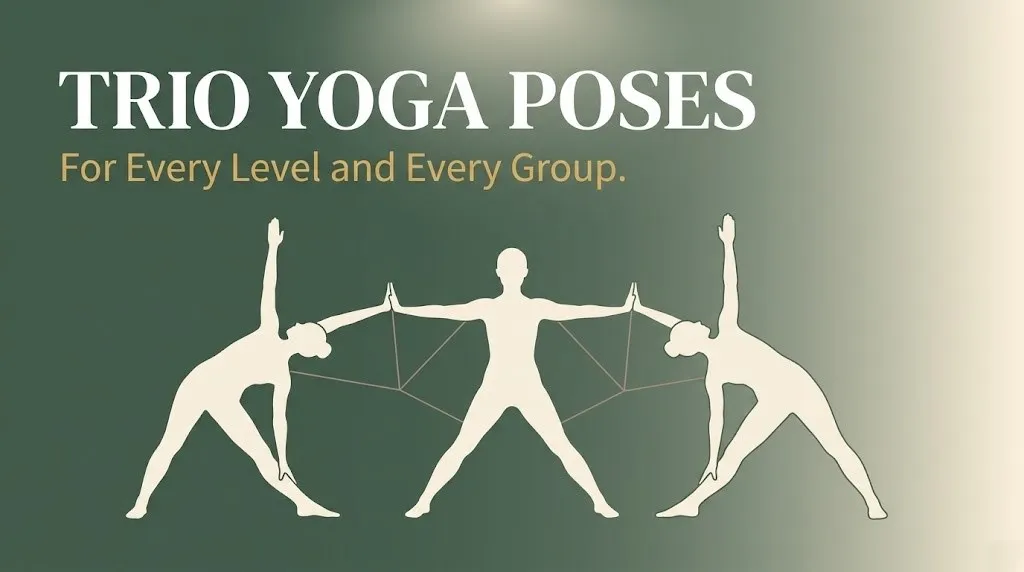
The Triple Trikonasana (Triple Triangle Pose) places all three practitioners in a line, each in a full Trikonasana (Triangle Pose) with their back foot pressed against the back foot of the person beside them. The physical contact at the feet creates a shared base of support and allows each practitioner to deepen their side extension by leaning slightly into the group rather than performing the pose in isolation.
To practice Triple Trikonasana (Triple Triangle Pose):
- Stand in a line of three, with approximately one arm’s length between each person.
- Step feet wide apart simultaneously. All three practitioners step the same distance.
- Turn your right foot out 90 degrees and left foot in 15 degrees. Press the outer left heel of the left-side person against the outer left heel of the center person, and repeat on the right.
- Reach the right arm forward and then lower it toward the floor or a block while the left arm extends upward. All three moving together.
- Gaze up toward the upper hand or straight ahead if the neck is sensitive.
- Hold for 5 breaths. Breathe together.
- Inhale to rise. Switch sides.
Modification: Place a yoga block under the lowering hand at any height to keep the spine long. Participants with lumbar spine sensitivity should use a taller block position and avoid rotating the upper body beyond comfort.
Trio Yoga Balance Poses Step by Step
Trio yoga balance poses are standing or kneeling shapes where at least one participant relies on the physical support of the others to maintain their position. They are the first category where a clear base-spotter-flyer dynamic applies.
The most accessible weight-sharing balance pose for a trio is the Triple Vrksasana (Triple Tree Pose). All three stand in a line. The center person balances on their right leg. The left and right flanking practitioners each place their inside foot against the center person’s standing leg at calf height for support, while all three press their inside palms together above the center person’s raised foot. No one bears another’s full weight; instead, the light hand and foot contact creates shared stability.
To practice Triple Vrksasana (Triple Tree Pose):
- Stand in a line of three with the center person between the outer two.
- All three shift weight onto the right foot simultaneously.
- Each outer practitioner bends the left knee and places the sole of the left foot against the center person’s right calf (below the knee only, never at the knee joint).
- The center person raises the right foot and places it on the inner left thigh, above the knee.
- All three press their inside palms together at shoulder height, creating a connected hand arch.
- Hold for 5 breaths. Gaze at a fixed point on the floor ahead.
- Lower simultaneously on a shared exhale. Repeat on the other side.
Safety note: Never place the raised foot directly against the knee joint in Tree Pose. Place it above (inner thigh) or below (inner calf). Lateral pressure on the knee is a common cause of ligament strain in this pose.
Intermediate Trio Yoga Poses for Mixed-Ability Groups
Intermediate trio yoga poses introduce counterbalancing, mild weight sharing between standing partners, and more complex coordination patterns. These are appropriate when all three practitioners are comfortable in the beginner and standing poses described above.
The Trio Counterbalance Utkatasana (Chair Pose Circle) is one of the most effective intermediate poses because it requires active leg strength from all three practitioners simultaneously while also training the communication and timing skills the group has been building. All three face inward, join hands in a circle, lean back simultaneously to take each other’s weight as a counterbalance, and sink into a shared Utkatasana (Chair Pose) position.
To practice Trio Counterbalance Utkatasana:
- Stand facing inward in a tight triangle. Feet hip-distance apart.
- Each person takes both wrists of their neighbors, creating a connected ring.
- On a shared exhale, all three lean back simultaneously, taking each other’s weight as a counterbalance.
- Begin to bend the knees and lower the hips as if sitting back into a chair. Keep the spine long.
- All three participants’ weight is distributed through the arms and the shared counterbalance, not through any single person.
- Hold for 5 breaths. Keep Ujjayi breath steady throughout.
- On a shared inhale, all three press into the ground and rise together.
Modification: Participants with knee conditions should reduce the depth of the squat to a quarter-squat position, keeping the thighs well above parallel. This reduces the patellofemoral load while maintaining the counterbalancing coordination challenge.
Hard Trio Yoga Poses for Experienced Practitioners
Hard trio yoga poses involve full body weight transfer from one or two practitioners onto a base, requiring substantial upper body and core strength, practiced communication, and a confident spotter throughout. These poses should only be attempted after all three participants are consistently comfortable in the intermediate category.
The Supported Three-Way Adho Mukha Svanasana (Downward Dog Stack) is one of the most recognizable hard trio poses. The base practitioner establishes a stable Adho Mukha Svanasana (Downward Facing Dog) with hands and feet firmly grounded. A second practitioner places their hands on the base’s lower back and their feet on the base’s upper back or shoulders, creating a second Downward Dog shape elevated above the first. The third practitioner serves as spotter throughout, standing at the side ready to support the flyer’s hips during entry and exit.
Important prerequisites before attempting:
- All three practitioners can hold solo Adho Mukha Svanasana for 10 or more breaths steadily
- The base practitioner can hold a stable plank position with 30 additional pounds of pressure on the hips without the lower back sagging
- A confident spotter is always present; this pose is not attempted without one
- Entry and exit are always guided verbally: base says “ready,” flyer waits for confirmation before adding weight
Safety note: The lower back of the base practitioner must remain flat throughout, not arched or sagging. A sagging lumbar spine under the additional load of a second person creates a high risk of lumbar strain. The base should exit the pose immediately if the lower back cannot remain neutral.
Modification: Replace the full stacked Downward Dog with a supported bridge position, where the base lies supine with feet flat and hips lifted, and the flyer stands on the base’s thighs (not knees) while the spotter holds the flyer’s hands for balance. This requires less upper body strength from the base and less balance from the flyer.
Key Takeaway: Hard trio poses require all three practitioners to have built strength, communication, and body awareness through easier poses first. Skipping the beginner and intermediate stages and attempting weight-bearing stacked poses is the fastest route to injury in group yoga.
Trio Yoga Poses for Kids and Families
Trio yoga poses work well for families because children naturally enjoy the physical playfulness and social connection of group movement. The most appropriate trio poses for families keep all participants at floor level, involve no weight bearing between adults and children, and prioritize fun over performance.
The best family trio yoga poses are the Triple Balasana (Triple Child’s Pose) circle, the Seated Twist Exchange, and the Group Boat Pose with bent knees. Each of these is accessible to children aged 5 and older with standard adult supervision. No child should serve as a base for an adult’s weight in any pose.
A family trio session format that works:
- Begin with 5 minutes of synchronized breathing lying on the floor, all three side by side
- Move into Triple Balasana, with all three in Child’s Pose, arms reaching toward the center so hands almost touch
- Practice the Seated Twist Exchange: sit in a triangle, each person puts a hand on their neighbor’s knee and twists gently, holding 5 breaths
- Try Group Boat Pose with bent knees, pressing feet together in a triangle and balancing together
- End with Triple Savasana: lie in a pinwheel formation with heads toward the center, one hand resting gently on each neighbor’s abdomen
Safety note: Children’s joints are more pliable than adults’ joints. Avoid any shape that places a child’s spine, wrists, or knees under compressive load from another person’s body weight. All family trio poses should be floor-based and weight-neutral between child and adult.
Trio Yoga Poses for Seniors and Older Adults
Trio yoga is highly accessible for older adults when all three practitioners use chair support, keep all poses at floor level or standing with wall access, and eliminate any weight-bearing between participants. The social connection element is particularly beneficial for seniors.
According to a 2019 study in the Journal of Alternative and Complementary Medicine, group yoga programs for older adults produced greater improvements in mood, pain scores, and social connectedness than individual home yoga practice over an 8-week period. The trio format creates this group effect even outside a formal class setting.
The most appropriate trio yoga format for seniors uses chairs as both a prop and a safety anchor. All three practitioners sit or stand behind their chairs, maintain grip on the chair back when needed, and connect through hand-holding or light shoulder touch rather than weight bearing.
Senior-friendly trio yoga poses:
| Pose | Formation | Support Used | Primary Benefit |
|---|---|---|---|
| Seated Synchronized Breathing | Chairs in triangle | Chairs | Nervous system calm, connection |
| Seated Three-Way Twist | Chairs in a line | Chair back | Thoracic spine mobility |
| Standing Side Stretch Circle | Standing, hands joined | Wall or chair nearby | Lateral trunk stretch |
| Chair Triple Forward Fold | Seated, arms extended forward | Chairs | Hamstring and back release |
| Seated Triple Savasana | Reclined or seated, hands joined | Chairs or floor | Full body relaxation |
Safety note: Older adults with osteoporosis should avoid deep forward folds that load the thoracic spine under flexion. A certified yoga teacher or physical therapist familiar with osteoporosis-specific yoga can advise on appropriate spinal positions.
AcroYoga Principles Applied to Trio Yoga
AcroYoga is a practice that combines traditional yoga with acrobatics and therapeutic flying, and it provides the most developed safety and technique framework for weight-bearing partner and group yoga. Understanding its core principles makes trio yoga significantly safer and more effective.
The three functional roles in AcroYoga, base, flyer, and spotter, translate directly to weight-bearing trio yoga. The base is the foundation, providing stable support from the ground. The flyer is the person elevated or partially supported. The spotter is the safety manager, never touching the flyer unless needed but always positioned to catch or lower them.
The AcroYoga principle of “low is safe, high is earned” is the most important concept for trio yoga practitioners without formal training. Any pose that elevates one person above another should only be attempted after the ground-level version has been mastered. There is no value in rushing to elevated shapes.
Core AcroYoga principles to apply to trio yoga:
- Low is safe, high is earned: always master the floor-level version before attempting elevation
- The spotter is always present in any weight-bearing shape: never two people without a third watching
- Stacked joints over soft tissue: support weight through bone alignment, not muscle gripping
- Communication before entry: base confirms readiness before any weight is added
- Exit before fatigue: don’t hold weight-bearing poses until someone’s arms give out; exit while still strong
- The flyer’s safety is the group’s responsibility: all three practitioners own the outcome of every shared shape
Trio Yoga Modifications and Props
Props in trio yoga serve the same purpose they do in solo practice: they make the correct alignment of a pose accessible before the body’s current flexibility or strength can achieve it unassisted. In trio yoga, props also reduce the load on supporting practitioners and allow all three to sustain poses longer with better form.
The four most useful props for a trio yoga session are yoga blocks, yoga straps, yoga blankets, and a wall. The wall is often overlooked as a prop in partner yoga, but it creates an invaluable third point of contact for standing balance poses where two practitioners are the other two contact points.
The American College of Sports Medicine notes that using physical supports during movement reduces compensatory patterns and maintains intended muscular engagement. In trio yoga, props keep the base practitioner’s joints stacked correctly and allow the flyer to sustain a position without gripping.
| Prop | Trio Yoga Application | Who Benefits |
|---|---|---|
| Yoga Block (2 per person) | Elevates hands in forward folds; supports base wrists | All levels, especially beginners |
| Yoga Strap | Connects feet in paired forward folds; assists grip | Practitioners with limited reach |
| Yoga Blanket | Cushions knees in kneeling base positions | Base practitioners, seniors |
| Wall | Third contact point in standing balance poses | Beginners, seniors, balance challenges |
| Non-Slip Mat (one per person) | Prevents mat movement under shared weight | All participants in weight-bearing poses |
Modification for wrist-sensitive practitioners in base roles: place folded blankets or yoga wedges under the wrists to reduce extension angle. This allows the base position to be maintained without aggravating carpal tunnel or wrist joint discomfort.
Trio Yoga Safety and Contraindications
Trio yoga carries specific safety considerations beyond standard solo yoga because at least one person’s safety may depend on the physical stability and communication of the other two. This shared responsibility changes what “safe practice” means.
The most common injury patterns in partner and group yoga are lumbar strain in base practitioners from inadequate core engagement during load, wrist impingement from weight-bearing poses without adequate wrist preparation, and knee joint strain in balance poses where contact is incorrectly placed at the knee rather than above or below it.
A 2016 study published in the Orthopaedic Journal of Sports Medicine found that the most common yoga injuries involved overstretching and improper execution under load. Both factors are amplified in trio yoga when communication breaks down or when the group skips the beginner stages to attempt harder shapes before the necessary strength is established.
Conditions requiring modification or exclusion from weight-bearing trio yoga:
- Active lumbar disc herniation: no base roles in weight-bearing poses; all trio practice should remain floor-level and non-loading
- Rotator cuff injury: avoid any pose that places the shoulder in a loaded overhead position; the base role in stacked poses is contraindicated
- Wrist fracture recovery: replace all hand weight-bearing with forearm positions; clear with an orthopedic specialist before returning to base roles
- Pregnancy (second trimester onward): avoid prone, supine-twist, and weight-bearing base positions; side-by-side standing and seated shapes are generally appropriate with guidance from a certified prenatal yoga teacher
- Osteoporosis: avoid all weight-bearing between practitioners; seated and standing non-contact trio poses are appropriate
- Recent joint surgery: the operating surgeon should specify when weight-bearing group exercise is safe to resume; do not assume recovery timelines from general guidelines
Safety note: The group exit rule is non-negotiable. If the base practitioner signals “down,” every other participant lowers immediately, regardless of how stable the pose feels to them. The base feels the load; the others may not.
Key Takeaway: Trio yoga safety comes from the group’s communication as much as from any individual’s strength. The stop signal, the joint-stacking principle, and the rule of never rushing past the beginner stages are the three rules that prevent the vast majority of group yoga injuries.
Frequently Asked Questions About Trio Yoga Poses
What are the easiest trio yoga poses for complete beginners?
The easiest trio yoga poses are grounded, seated shapes where all three practitioners remain at the same height with no weight sharing.
Triple Sukhasana (three practitioners sitting back-to-back in a triangle), Triple Balasana (Child’s Pose side by side), and the Seated Twist Exchange are ideal starting points.
These poses build the breath coordination and physical trust that more complex shapes require, without any fall risk.
How do three people coordinate in a yoga pose safely?
Three people coordinate in trio yoga through verbal check-ins, a shared breath cue before transitions, and an agreed stop signal that means everyone lowers immediately.
The supporting practitioner always asks “ready?” and waits for a clear verbal confirmation before adding weight or changing position.
Breath synchronization, all three inhaling and exhaling together, is the most effective coordination tool once the group is familiar with the sequence.
Can kids do trio yoga poses with adults?
Children aged 5 and older can participate in seated and standing floor-level trio yoga poses safely alongside adults.
No child should serve as a base for an adult’s weight in any pose; all family trio shapes should be weight-neutral between child and adult.
The best family trio poses are Triple Balasana, the Seated Twist Exchange, and Group Boat Pose with bent knees, which are accessible and genuinely fun for mixed ages.
What muscles do trio yoga poses work most?
Trio yoga poses primarily engage the core stabilizers, glutes, quadriceps, shoulder girdle, and hip stabilizers, depending on the pose category.
Standing and balance poses load the lower body and core, while base roles in weight-bearing poses require sustained serratus anterior and rotator cuff engagement.
The counterbalancing mechanics of group poses also recruit the deep spinal stabilizers more actively than equivalent solo yoga shapes.
Do I need yoga experience to try trio yoga poses?
No prior yoga experience is required to start with beginner trio yoga poses like Triple Mountain Pose, the Seated Twist Exchange, or Triple Child’s Pose.
Basic familiarity with how yoga breath works, slow nasal breathing coordinated with movement, makes the experience more comfortable and reduces the coordination learning curve.
Anyone attempting intermediate or weight-bearing trio yoga should practice the individual poses (Downward Dog, Boat Pose, Tree Pose) in solo form first so the group session focuses on coordination rather than learning the shapes from scratch.
Choose One Pose, Find Your Two People, and Start Today
The biggest obstacle to trio yoga is not physical. It is simply deciding to try it. Pick the Triple Sukhasana from the beginner section: three people, a triangle formation on the floor, backs touching, 5 minutes of shared breathing. That is a complete practice in itself.
From there, work through the seated and standing poses in order. Don’t skip to the balance work or the harder shapes until the group feels genuinely coordinated in the simpler ones.
Trio yoga is built on trust. The poses are the vehicle. The connection is the point.